The limit is the radiusSection 3
Forty-eight turns, and none of them widen
The Stelvio Pass climbs from Prato allo Stelvio through forty-eight numbered hairpins to 2,757 metres. The number is decorative. The radius is not.
The north side is the problem
The Stelvio Pass — Passo dello Stelvio in Italian — is the second-highest paved road in the Alps and the highest in Italy. It carries a number: SS38. It also carries a reputation that tends to arrive in one of two registers, either the cycling stage or the automotive television spectacle, and neither version is much use to someone sitting in a seven-metre motorhome at the foot of Prato allo Stelvio wondering whether the road actually goes where the map says it does.
It does go there. The question is whether the vehicle goes with it.
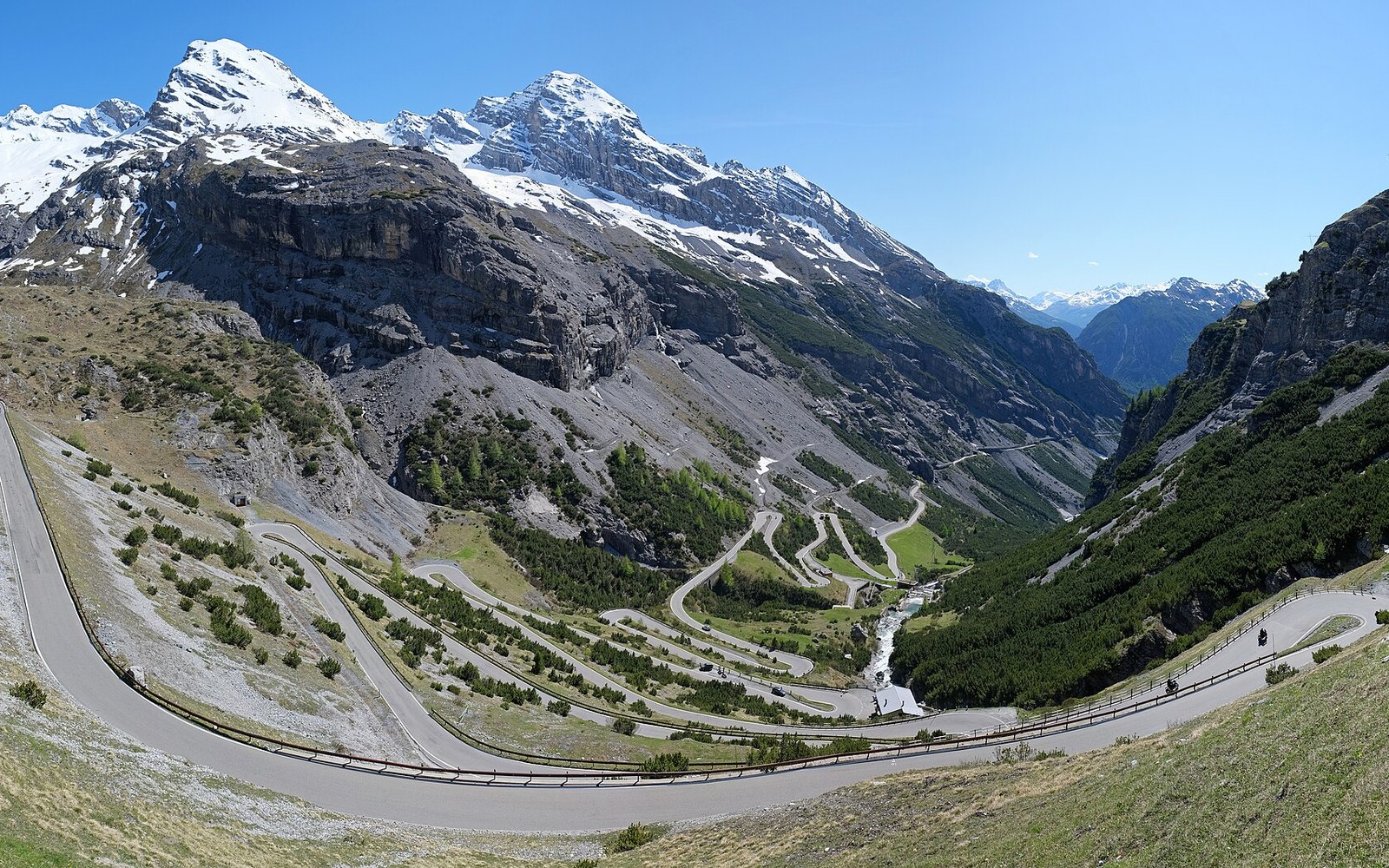
The north side, rising from Prato allo Stelvio toward the summit, is the side with the forty-eight numbered turns. The bends are marked with white-painted stones carrying black numerals, counted upward from the valley and downward from the top depending on which numbering convention the source uses — the stones themselves begin at forty-eight at Prato and count down to one at the pass. They were built under Austrian administration between 1820 and 1825 by military engineer Carlo Donegani, whose brief was a road capable of moving artillery. The width that resulted was adequate for a cannon and a mule team; it is less generous with a vehicle whose rear overhang describes an arc that the front wheels have already committed to and cannot correct.
The geometry of a hairpin on the Stelvio north face is not a question of gradient, which is demanding but manageable, peaking at around twelve percent on certain ramps. It is a question of inner radius. The tightest turns on the numbered sequence have an inner radius that a long wheelbase will simply not negotiate in a single lock: the front clears, the rear does not follow, and the driver is presented with the choice of reversing — on a narrow shelf above a substantial drop — or not having started. The distinction between those outcomes is made at the bottom of the pass, not the middle.
What the measurement decides
A vehicle's turning circle relative to its wheelbase is the operative figure here, not the length in isolation. A compact panel van with a short wheelbase can handle the Stelvio north face. A coachbuilt motorhome on a long-wheelbase chassis, typically anything built on a base exceeding around four metres between axles, will encounter multiple turns where a single-pass negotiation is marginal or impossible. Rear overhangs beyond about 1.5 metres past the rear axle make the calculation worse, because the overhang swings outward as the vehicle turns and can meet the rock wall or the barrier before the tyres do.
The Stelvio is not subject to a formal length prohibition in the way that some Alpine routes post explicit vehicle-length signs. What operates instead is geometry — absolute and silent. The road does not warn in advance that a particular turn will not accommodate a particular turning circle. The numbered stones count the hairpins; they do not grade them by radius. Reconnaissance via satellite imagery shows the general character but not the precise inner line, which varies turn by turn as the road was cut into different rock profiles across its original five-year construction.
The numbered stones count the hairpins; they do not grade them by radius.
The south side, descending toward Bormio, is a different road in practical terms. It carries far fewer tight hairpins — the slope is steeper but the bends are less numerous and generally wider. Drivers who have come over from Bormio and found the north face manageable have sometimes made the error of assuming the reverse journey shares that character. It does not. The descent toward Prato allo Stelvio is not a mirror of the climb from it.
The pass in its wider context
The Stelvio is in the Ortler Alps in the eastern Lombardy–South Tyrol border zone, not in the Dolomites proper, though the two massifs are sometimes conflated in travel writing. The Dolomites sit to the east; the Ortler group, of which the Stelvio Pass forms the principal road crossing, is a separate range, higher in its summits and more glaciated. The distinction matters less aesthetically than operationally: the road network around the Stelvio does not connect conveniently to the principal Dolomite valley routes, and a route planned to include both requires a significant detour through the Vinschgau or via Merano.
The pass is closed for winter — typically from November through late May or early June, though the exact dates vary by snowfall and are confirmed annually by the road authority. The opening date each year is established by the Province of Sondrio on the Lombardy side and the Province of Bolzano on the South Tyrol side, and neither authority is bound to a fixed calendar. A route built around an early-season crossing without confirmation of the opening date is a route built on optimism rather than information.
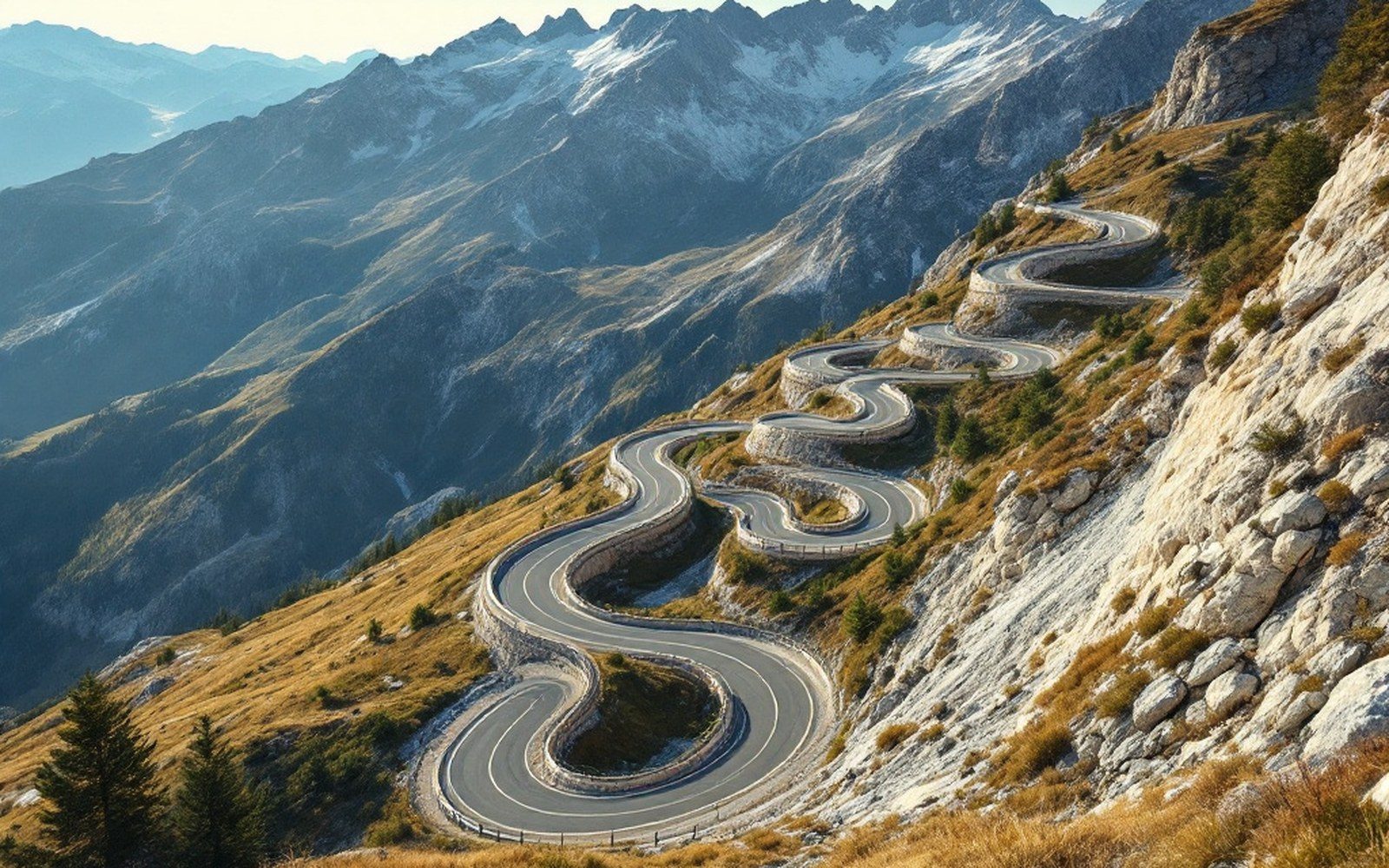
When the pass is open, it carries significant tourist traffic in July and August. Motorcycles dominate the numbered hairpin section on weekends; cycling sportive events close the road periodically, announced in advance by the relevant provincial road administrations. Both conditions affect a slow, wide vehicle more than they affect lighter traffic, because overtaking is not available on the hairpin sequence and the ability to hold a consistent line through a tight turn is degraded by queuing or by the need to allow a peloton to pass.
Prato allo Stelvio as the decision point
Prato allo Stelvio, the village at the foot of the north ramp, sits at around 900 metres and is the last point at which a turn is straightforward. The road narrows and commits above the village, and the first hairpins begin within a few kilometres of leaving the valley floor. There is no useful staging point partway up where a vehicle in difficulty can turn around without significant reversing on a narrow road with traffic behind it.
The village itself has an area di sosta — a service point for campervans — which functions as both a practical stop and an involuntary terminus for vehicles that, on reflection or after a direct look at the ramp above, decide not to continue. This is not a failure of planning; it is planning. The Stelvio is a road that rewards honesty about wheelbase and turning circle more than it rewards ambition.
Carlo Donegani built a road for the requirements of his time, and the remarkable engineering achievement of the north face — forty-eight hairpins on a climb of roughly twenty-five kilometres — has not been widened to meet the requirements of a later century's recreational vehicles. The numbered stones count upward from the valley. They do not promise arrival at the top. That depends entirely on the measurement taken before the first stone is reached, on flat ground, where the calculation is still theoretical and the reversing is still easy.
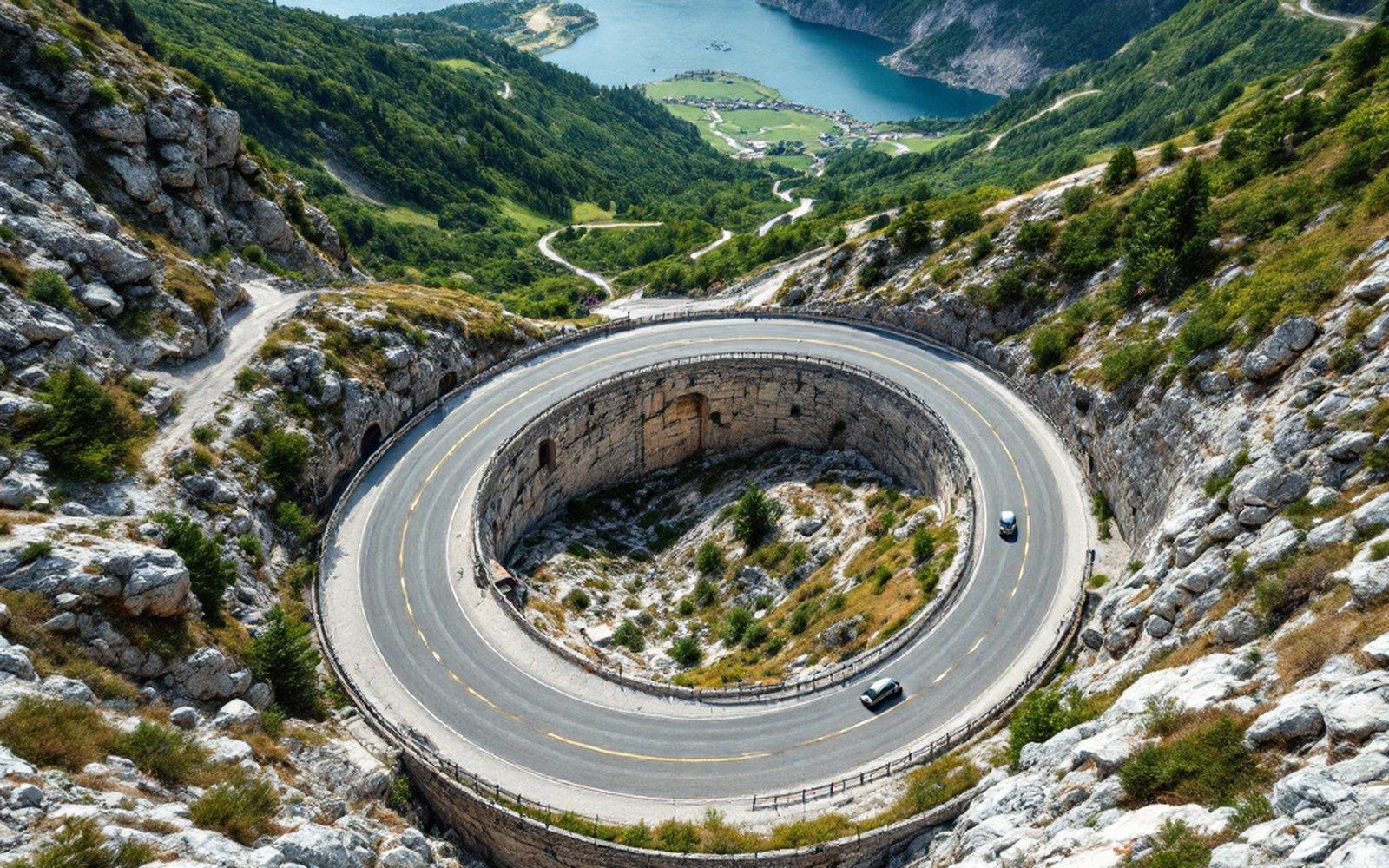
The descent toward Prato allo Stelvio is not a mirror of the climb from it.